

New Customer Hours
Mon - Sat: 9:00am - 5:00pm
Customer Care Hours
Mon - Sat: 9:00am - 5:00pm

TDU charges Texas residents see on every electricity bill pay for the physical delivery of power from generation sources to homes and businesses. In Texas’s deregulated market, your
energy provider handles billing and customer service, while separate transmission and distribution utilities maintain the power lines, meters, and infrastructure.
This guide explains how TDU rates are determined, why they vary across regions served by Oncor, CenterPoint Energy, and AEP Texas, and how different electricity plan structures affect your total costs. Understanding these charges helps you make informed decisions about energy usage and plan
selection, especially if you’re considering prepaid electricity options that eliminate reconnection fees and deposit requirements.
What Are TDU Charges?
Transmission and distribution utilities own and maintain the physical infrastructure that delivers electricity to your home, including power lines, transformers, substations, and meters. These companies operate as regulated monopolies overseen by the Public Utility Commission of Texas,
meaning they don’t compete with each other, and their electricity rates are set through regulatory review rather than market forces.
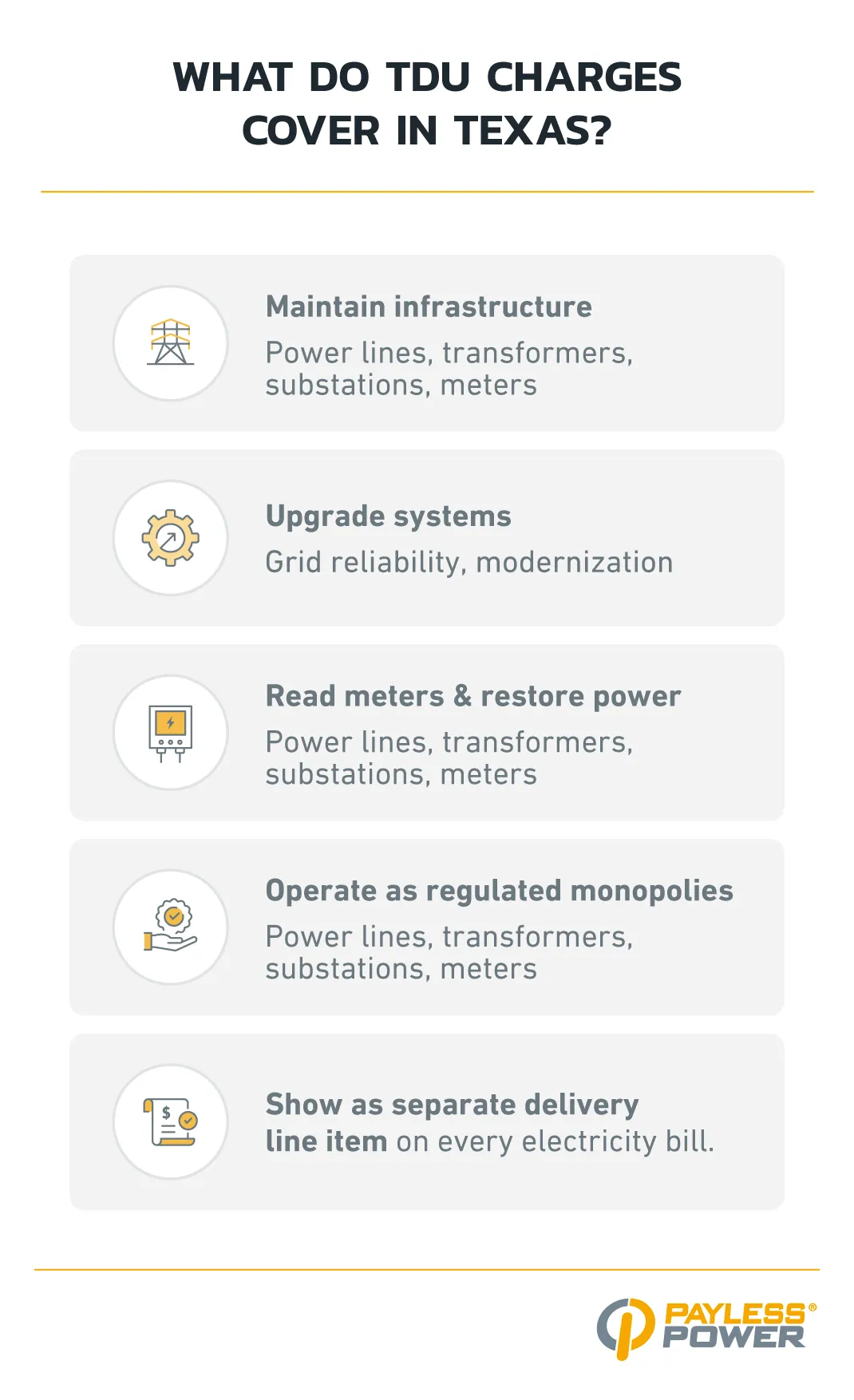
Every Texan pays TDU delivery charges regardless of which retail electricity provider they choose. These fees cover infrastructure maintenance, system upgrades,
meter reading, outage restoration, and grid reliability improvements. Because TDUs handle the wires and poles while your energy provider handles generation and billing, your electric bill shows separate charges for energy supply and delivery.
The PUCT publishes TDU rate sheets for all service territories, providing transparency into how delivery rates are calculated and updated throughout the year.
How TDU Rates Are Determined
The Public Utility Commission of Texas sets and updates TDU delivery rates through a regulatory process that balances infrastructure costs with consumer protection:
- PUCT reviews and approves rates multiple times per year. Each transmission and distribution utility submits rate proposals reflecting operating costs, capital investments, and projected demand in its service area.
- Rates vary by region based on infrastructure needs. Oncor serves North and West Texas; CenterPoint Energy covers Houston; AEP Texas North operates in the Panhandle and West Texas; and AEP Texas Central serves Corpus Christi.
- Base charges cover fixed costs regardless of usage. These flat monthly fees pay for customer service, billing systems, and meter maintenance.
- Delivery fees calculate per kilowatt-hour. These charges vary based on your consumption level and cover transmission through high-voltage lines and distribution to your meter.
- TDSP charges include pass-through costs. Additional line items may appear for specific programs or infrastructure projects approved by the PUCT.
Why Do TDU Charges Change?
TDU delivery rates adjust periodically to reflect the actual costs of maintaining reliable electricity infrastructure across Texas. Here are the main reasons rates change:
-
Grid maintenance and infrastructure upgrades. Equipment ages and weather events damage transmission lines and substations, requiring billions in
system hardening, storm-proofing, and capacity expansion that flow through to delivery rates. - Storm recovery fees after severe weather. Hurricanes and ice storms cause widespread damage, and TDUs recover repair costs through temporary surcharges spread across all customers in the affected service area.
- Fuel costs for backup generation at critical facilities. TDUs maintain backup power systems at key infrastructure points, and fuel price fluctuations affect operational expenses reflected in rate adjustments.
- Population growth in expanding cities. Rapidly growing metro areas force utilities to build new substations and extend distribution lines, raising capital costs that affect delivery rates.
- Preventive maintenance schedules. Regular inspections, equipment replacements, and system upgrades prevent outages but require ongoing investment recovered through PUCT-approved rate increases.
Seasonal variations in your TDU delivery charge typically reflect higher usage during summer and winter peak periods rather than actual rate increases. Your delivery charge looks higher in July because you consumed more kilowatt-hours running air conditioning, even though the per-kWh rate
remained constant.
Breaking Down Your Electricity Bill
A typical Texas electricity bill separates energy charges from TDU delivery charges to show what you’re paying for generation versus transmission and distribution.
Understanding these line items helps you identify where costs accumulate:
- Energy charge. This reflects the cost of generating electricity and is set by your retail electricity provider based on your contracted rate, multiplying your kilowatt-hour usage by your plan’s per-kWh rate.
- Base charge. This flat monthly fee covers fixed costs your TDU incurs regardless of usage, such as meter maintenance and billing systems, and appears even if you consume zero kilowatt-hours.
- Delivery fees. These are calculated per kWh and cover the power transmitted through high-voltage lines and distributed through local infrastructure to your meter.
- Taxes. State and local sales tax applies to both energy and delivery charges on your monthly bill.
- Pass-through charges. These separate line items cover specific programs like energy efficiency initiatives or renewable energy credits mandated by state law.
- Miscellaneous fees. Depending on your electricity plan terms, these can include late payment charges, paper bill fees, or one-time connection costs.
Prepaid Power vs. Traditional Electricity Plans
Prepaid and traditional postpaid electricity plans handle billing and service fees differently, affecting your total costs and payment flexibility.
Prepaid vs. Postpaid Electricity Plans |
|
|---|---|
| Prepaid electricity | Traditional postpaid plans |
| Pay up front for electricity before using it; add funds as needed through online payments, MoneyGram, or other methods. | Receive monthly bills after using electricity; payment is due within 15–20 days of the billing date. |
|
No deposit required; service activates the same day without credit checks. |
Deposits required for customers with poor credit or no credit history can equal two months of estimated usage. |
| No reconnection fees if service lapses; simply add funds to restore power. | Reconnection fees range from $25 to $50 when service is disconnected for nonpayment. |
| Daily usage alerts and online account access help track consumption in real time. | Monthly statements show usage after the billing cycle ends; limited real-time visibility. |
| TDU delivery charges and taxes are passed through transparently on each transaction. | TDU charges and taxes appear as separate line items on monthly bills. |
Traditional postpaid plans charge extra fees for service reconnection after disconnection, adding unexpected costs when payment issues arise.
Payless Power customers pay up front for electricity, avoiding hidden delivery charges or reconnection penalties if their account balance runs low. Prepaid electricity provides transparency through daily usage updates and immediate visibility into how TDU charges affect your total costs.
Ways To Reduce Your Electricity Delivery Costs
Managing household expenses matters more as energy costs rise and economic uncertainty affects family budgets. While you can’t negotiate TDU delivery rates, they’re fixed by the PUCT, you can lower your total electricity bill through smart usage habits and plan selection.
- Choose energy-efficient appliances. Modern refrigerators, air conditioners, and water heaters use significantly fewer kilowatt-hours than older models, reducing both your energy charge and TDU delivery fees based on consumption.
- Track daily usage through your provider’s online tools. Payless Power offers real-time monitoring that shows how your daily habits affect costs, helping you identify peak usage periods and adjust accordingly.
- Select the right plan type for your consumption patterns. Energy plans like a fixed-rate option work well for predictable usage, while prepaid electricity gives you flexibility to manage costs week by week without monthly billing surprises.
- Improve home insulation and seal air leaks. Reducing the workload on heating and cooling systems lowers overall kilowatt-hour consumption, decreasing the delivery fees calculated per kWh on your monthly bill.
- Use programmable thermostats to optimize climate control. Setting temperatures higher in summer and lower in winter during peak hours reduces demand during the most expensive periods in the energy market.
TDU charges remain consistent across all retail electricity providers in your service area, but your total monthly charge depends heavily on usage. Payless Power’s payment options, including MoneyGram and online transfers, make it easy to add funds and monitor your balance, giving you
control over when and how much you spend on electricity.
How TDU Fees Impact Texans by Region
TDU (Transmission & Distribution Utility) charges vary by region based on infrastructure needs, weather risks, and population density:
- Oncor Electric Delivery operates in Dallas–Fort Worth, West Texas, and North Texas, serving over 10 million customers across the state’s largest territory.
- CenterPoint Energy serves the Greater Houston area, where hurricane risk and high humidity drive major grid hardening investments.
- AEP Texas North provides electricity to the Panhandle and rural West Texas, where long distances between customers increase delivery costs.
- AEP Texas Central operates in and around Corpus Christi, where coastal weather and tourism affect infrastructure needs.
- Local utilities and municipal providers serve smaller regions outside major metro areas, each with its own PUCT-approved rate structure.
Regional weather patterns and infrastructure demands are the main reasons TDU delivery rates differ across Texas.
What Texans Should Know About Utility Fees
Understanding how TDU charges work helps you make informed decisions about electricity plans and usage habits. Here’s what every Texas electricity customer should know:
- TDU charges are fixed and regulated. The Public Utility Commission of Texas sets delivery rates that apply equally across all retail electricity providers serving your area, so that no energy provider can negotiate lower TDU fees on your behalf.
- You control what you can change. While delivery costs remain constant, plan selection and usage habits significantly affect your total electricity bill and monthly expenses.
-
The Electricity Facts Label shows total costs. Every plan’s EFL breaks down both energy charges and estimated TDU delivery fees at
different usage levels, helping you compare actual total costs rather than just advertised rates. - Monitoring usage reveals cost-driving patterns. Online tools and mobile apps show how daily habits affect your energy bill, helping you adjust thermostats, shift appliance use to off-peak hours, and reduce kilowatt-hour consumption.
- Small efficiency changes add up. Upgrading to LED lighting, improving insulation, and choosing energy-efficient appliances lower both energy charges and TDU delivery fees calculated per kWh.
- Prepaid electricity offers transparency and flexibility. Payless Power provides clear pricing, daily usage updates, and flexible payment options that help you avoid reconnection fees and surprise charges while managing costs proactively.

Making Sense of Texas Utility Fees
TDU charges, delivery fees, and taxes work together to form the total cost you see on your Texas electricity bill. The Public Utility Commission of Texas regulates delivery rates uniformly, so every retail electricity provider passes the same TDU charges to customers in a given service area.
Your energy rate, set by your chosen REP, combines with these fixed delivery costs to determine your monthly expense.
While TDU charges can’t be avoided, your electricity plan structure and daily usage habits significantly impact total costs. Fixed-rate plans protect you from energy market volatility, and prepaid electricity helps you manage expenses by eliminating deposit requirements and reconnection
fees. Monitoring usage through real-time tools gives you the information needed to adjust consumption and reduce both energy charges and delivery fees.
Payless Power offers prepaid electricity plans designed for Texans who want transparent pricing and flexible payment options without the surprise charges that often appear on traditional postpaid bills.
Enroll with Payless Power today to take control of your electricity costs and start managing your energy usage proactively.
FAQ About TDU Charges in Texas
These frequently asked questions address common concerns Texas customers have about the delivery charges, energy rates, and billing components that appear on their monthly electricity bills.
Why is my TDU delivery charge so high?
TDU delivery charges increase with higher kilowatt-hour consumption because delivery fees are calculated per kWh plus fixed base charges. Seasonal usage spikes from air conditioning or heating raise total consumption, making charges appear high even when rates stay constant. Recent
PUCT-approved rate updates also affect costs as TDUs recover infrastructure investments.
Why are energy and delivery charges different on my electric bill?
Energy charges pay for generating electricity, while delivery charges cover transmitting power through lines to your home. Texas deregulation separates these functions; your retail electricity provider handles supply, while the transmission and distribution utility maintains infrastructure.
The PUCT regulates TDUs as monopolies, so delivery charges stay consistent regardless of your energy provider.
What runs your electric bill up the most in Texas?
Extreme heat drives electricity usage higher as air conditioning accounts for the largest share of summer consumption. Running cooling systems during 100-degree days can massively increase your kilowatt-hour usage. Higher consumption increases both energy charges and TDU delivery charges.
Inefficient appliances and poor insulation also force systems to work harder, further raising costs.
Who determines TDU delivery fees?
The Public Utility Commission of Texas reviews and regulates TDU delivery rates statewide. Oncor, CenterPoint Energy, and AEP Texas submit rate proposals based on infrastructure costs and maintenance needs. The PUCT evaluates whether requested rates reflect prudent utility management. This
process ensures delivery fees remain fair and cost-based.
Payless Power is a thought leader in the energy industry, focusing on technology, innovation, and accessibility. The company's expertise includes the Texas energy grid, infrastructure improvements, weatherization safeguards, and the advancement of clean, renewable resources. Since 2005, Payless Power has provided energy solutions to residences and businesses across the Lone Star state.
Related Posts
-
 How Tidal Energy Works and Its Potential as a Renewable Energy Source
-
 Hydrogen Fuel Cells: The Advantages and Challenges
-
 The Impact of Electric Vehicles on the Power Grid
-
 The Impact of Energy Efficiency on Urban Sustainability
-
 The Promise of Geothermal Energy: An Underutilized Resource?
-
 Wind Energy: The Pros and Cons of Onshore vs. Offshore Turbines
What our customers are saying
See why our power customers say we're the best electricity provider in Texas!

I was worried about getting electricity for my home through a prepaid company. I was calling around to see different rates then going through all the hassle of credit checks while dropping points each…
I have been with this company for several years and have been very happy since. Even when I moved, they made my usually stressful situation very easy and carefree. I recommend them to everyone that I…
I have enjoyed the service for 2 years now. In the beginning this service was planned to be temporary but with the service being so effective for me i decided to keep it for the long haul. I’m a happy customer.
*Same-day connection is available Monday through Saturday when you fund your account before 6:00 PM. Accounts funded after 6:00 PM, on Sundays, or on holidays will be connected first thing the next morning. Actual timing depends on your local utility company. Connection times are not guaranteed and may be delayed due to meter issues, switch holds, system outages, or weather. Our support team is always standing by to help.
About Payless Power
Payless Power wants to be your Texas electric company.
Whether you live in a large city or small town, Payless Power can save you money on your Texas electricity. We serve customers in over 400 deregulated communities in Texas with both traditional, postpaid plans on monthly billing cycles, and prepaid electricity that is pay-as-you-go with no deposit or credit check required.
We work with principal utilities throughout the state to provide electricity. The utilities are: Oncor in the Dallas and Fort Worth Metroplex and various parts of West Texas; CenterPoint Energy in Houston and the surrounding areas; AEP Central in Corpus Christi and surrounding areas; and AEP North in Abilene and other North Texas communities.