
New Customer Hours
Mon - Sat: 9:00am - 5:00pm
Customer Care Hours
Mon - Sat: 9:00am - 5:00pm

Power outages are becoming a growing concern for households across the United States. From severe storms to aging infrastructure, disruptions to the electric grid can leave families without power for hours or even days.
Payless Power analyzed federal outage data across all 50 states and surveyed more than 1,000 Americans about their experiences and preparedness. Learn which states keep the lights on most reliably, and how ready Americans truly are for when outages strike.
Key Takeaways
- Arizona ranks as the No. 1 state for grid reliability in the U.S.
- Louisiana, Maine, and West Virginia rank as the 3 least reliable states for power outages in the U.S.
- Louisiana residents spend nearly 34 hours a year without power, the most of any state in the nation.
- Only 39% of Americans are highly confident that their power grid could withstand a major disruption, while 22% say they are not confident.
- 29% of Americans have experienced 3 or more major power outages in the past 5 years, and for 31%, their worst outage reduced trust in their utility’s ability to respond in the future.
- 35% of Americans say their emergency supplies would last 2 days or less, and 8% report having none.
- More than one-third of Americans (37%) report having no backup power solution at home.
Ranking the Grid
Electricity reliability varies a lot depending on where Americans live. By analyzing 5 years of federal outage data, our Power Security Index reveals which states maintain the most dependable electric service and which struggle the most.
Arizona ranked as the most reliable state for power outages in the United States, earning a Power Security Index score of 96.3 out of 100. On average, Arizona residents lose power for only 1.7 hours per year. Delaware followed in second place, while Nevada ranked.
Top 10 Most Reliable States for Power
- Arizona — 1.7 hours a year without power (score: 96.3)
- Delaware — 2.1 hours (score: 81.2)
- Nevada — 2.2 hours (score: 79.0)
- South Dakota — 2.3 hours (score: 76.7)
- Maryland — 2.6 hours (score: 70.1)
- Colorado — 2.7 hours (score: 68.3)
- Minnesota — 2.9 hours (score: 65.1)
- Illinois — 3.0 hours (score: 64.9)
- Wyoming — 3.0 hours (score: 63.5)
- New Mexico — 3.3 hours (score: 58.6)
At the opposite end of the ranking, Louisiana, Maine, and West Virginia emerged as the least reliable states for electricity service. Residents in Louisiana spent an average of nearly 34 hours a year without power, the highest total nationwide. Maine and West Virginia also reported significantly higher outage durations than most other states.
Bottom 10 Least Reliable States for Power
- Louisiana — 33.5 hours a year without power (score: 13.9)
- Maine — 22.1 hours (score: 16.7)
- West Virginia — 15.5 hours (score: 20.9)
- Mississippi — 14.8 hours (score: 21.4)
- Oklahoma — 14.9 hours (score: 23.1)
- South Carolina — 13.5 hours (score: 24.4)
- Texas — 12.0 hours (score: 24.7)
- Vermont — 9.9 hours (score: 27.8)
- Michigan — 11.2 hours (score: 27.9)
- Arkansas — 9.5 hours (score: 28.6)
Texas also ranked in the bottom ten, with residents spending about 12 hours a year without power on average, well above the national average of 7.4 hours. Even in states with extensive energy infrastructure, outages remain a recurring issue for many households.
America’s Outage Reality
Power outages are more than an inconvenience. They also impact how Americans view the reliability of their energy system. Frequent disruptions and past experiences are shaping public confidence in the grid.
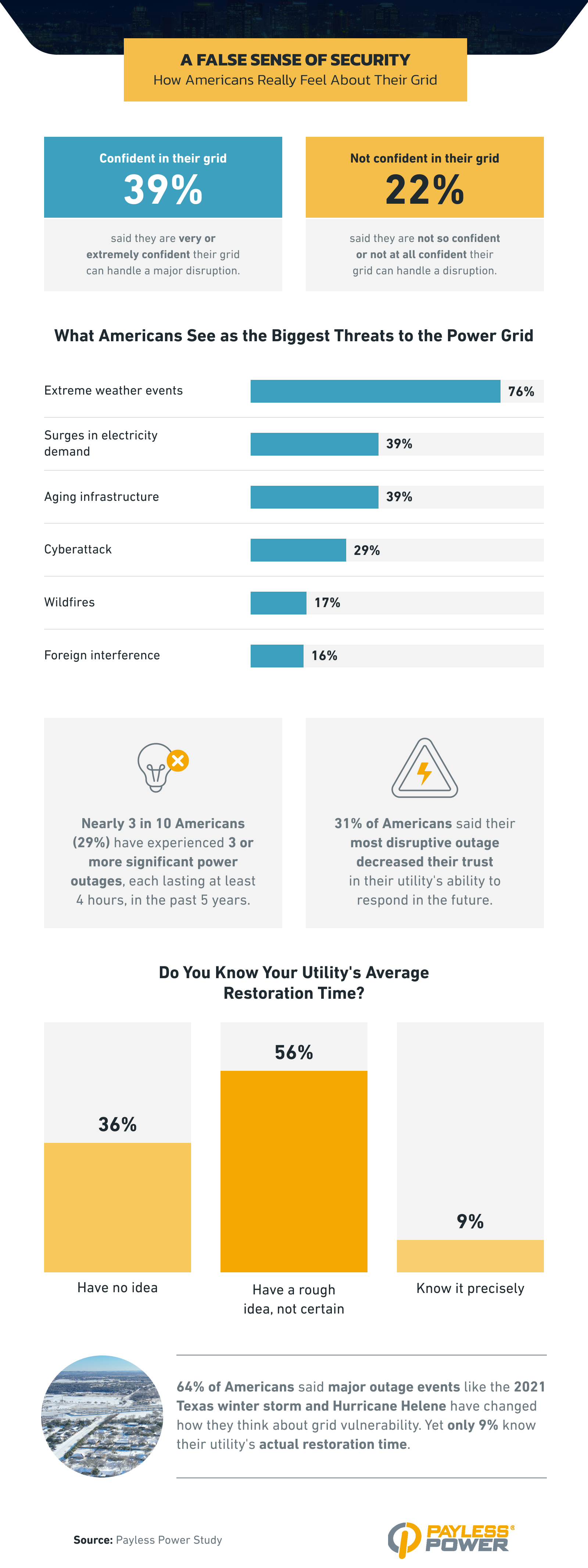
Confidence in the power grid remains limited. Only 39% of Americans said they felt highly confident their power grid could withstand a major disruption, while 22% reported they were not confident at all.
Another 31% said their worst outage reduced their confidence in their utility’s ability to respond effectively in the future. Texas and Massachusetts led the country, with 60% of residents in both states reporting decreased trust in their utility provider, and were followed by:
- Tennessee — 40%
- New Jersey — 39%
- Ohio — 37%
- Kentucky — 37%
- California — 36%
- North Carolina — 36%
- Georgia — 33%
- Virginia — 32%
Nearly a third of Americans (29%) reported experiencing 3 or more significant outages in the past 5 years. Michigan residents reported the highest rate at 48%, followed by:
- Tennessee — 44%
- Arizona — 44%
- Texas — 43%
- Kentucky — 41%
- Washington — 39%
- Nevada — 38%
- Georgia — 33%
- Florida — 30%
- Indiana — 30%
Concerns about grid investment are also widespread. Nearly 1 in 4 Americans (23%) said their utility is not investing enough in modernizing and strengthening the power grid in their area. The top 10 states most likely to believe their utility is not investing enough include:
- Kentucky — 41%
- Texas — 38%
- Michigan — 36%
- Colorado — 35%
- North Carolina — 30%
- Ohio — 29%
- Illinois — 27%
- New Jersey — 26%
- South Carolina — 25%
- Maryland — 24%
The Backup Problem
When outages happen, household preparedness becomes critical. Many Americans still lack the supplies and backup power needed to handle extended disruptions.
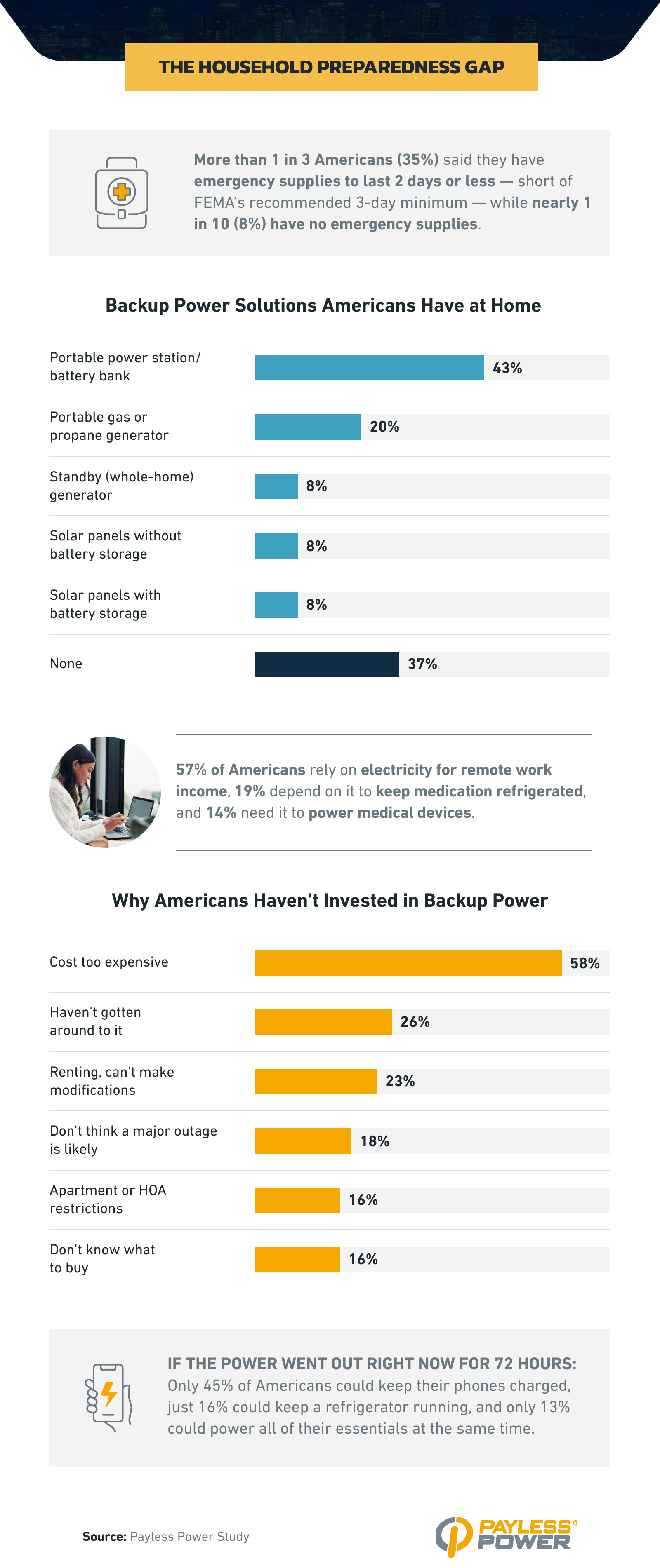
Thirty-five percent of Americans said their emergency supplies would last 2 days or less, while 8% reported having no emergency supplies at all. Backup power solutions are also far from universal.
More than one-third of Americans (37%) reported having no backup power option at home. Among the 57% of Americans who depend on remote work income, 35% of those workers have no backup protection in place.
Top 10 States Most Likely to Have No Backup Power
- Massachusetts — 60%
- Minnesota — 59%
- Nevada — 56%
- North Carolina — 52%
- Maryland — 50%
- Michigan — 45%
- Kentucky — 43%
- Indiana — 43%
- New York — 40%
- Illinois — 40%
Housing restrictions also limit many renters’ preparedness. About half (51%) said their inability to modify their home prevents them from installing backup power. Another 29% cited HOA or apartment restrictions, while 16% said their landlord does not allow generators.
Top 10 States Most Likely to Have Backup Power
- Arizona — 84%
- Tennessee — 82%
- Oregon — 81%
- Ohio — 77%
- Washington — 74%
- Virginia — 73%
- Wisconsin — 73%
- Florida — 72%
- South Carolina — 70%
- California — 69%
Texas ranked near the middle, with 63% of residents reporting access to some form of backup power. That placed the state 14th among those most likely to have backup power, showing moderate preparedness compared to the rest of the country.
When the Grid Fails, Preparedness Matters
Power outages remain a reality for millions of Americans each year. Federal outage reports show that reliability varies widely across states, while survey results indicate that many households remain uncertain about the grid’s ability to withstand major disruptions.
Frequent outages, declining trust in utilities, and limited backup power solutions all contribute to growing concern about energy security at home. Even in states with strong reliability scores, households may still face unexpected disruptions that interrupt daily life and work.
As extreme weather and infrastructure challenges continue to test the grid, household preparedness is becoming increasingly important. Understanding your risk and preparing for outages before they happen can make all the difference when the lights go out.
Methodology
Payless Power surveyed 1,003 American adults who pay electricity bills to explore attitudes, preparedness levels, and perceptions around power grid reliability and household energy security. The survey was conducted in March 2026. The findings reflect a non-scientific, exploratory study and are not intended to be nationally representative of all U.S. electricity customers.
The Power Security Index ranks all 50 U.S. states across three weighted indicators that capture the reliability of each state’s power grid, including:
- Avg. Annual Outage Minutes Per Customer (50%): The average total number of minutes per year a customer in a given state experienced a power outage, sourced from EIA Form 861 utility reliability data (2020-2024). This metric carries the heaviest weight as it most directly reflects the cumulative burden of outages on customers.
- Avg. Annual Outages Per Customer (25%): The average number of distinct outage events experienced per customer per year, capturing how frequently customers lose power regardless of duration.
- Avg. Minutes to Restore Power Per Outage (25%): The average time utilities took to restore power once an outage occurred, reflecting how quickly a state’s utilities respond to and resolve outages.
All three indicators reflect 5-year averages (2020-2024) to smooth out anomalous single-year events such as major hurricanes or winter storms. Each metric was scored using inverse-weighted normalization, where lower values yield higher scores, and scaled proportionally to each indicator’s maximum value before being combined into a final score out of 100. A score of 100 indicates perfect reliability across all 50 states; a score closer to 0 indicates the least reliability. Data was sourced from the U.S. Energy Information Administration (EIA) Form 861 annual electric power industry reports.
About Payless Power
Payless Power offers affordable, flexible electricity plans for Texas residents, including prepaid and no-deposit options that make power accessible to everyone. Customers can enjoy simple enrollment, predictable energy management, and plans that work for households with a wide range of credit backgrounds. Learn more about Payless Power’s electricity plans and how they help Texans stay powered with greater control over their energy costs today.
Fair Use Statement
This content may be shared for noncommercial purposes only. If referenced or redistributed, please include proper attribution and a link back to Payless Power.
Payless Power is a thought leader in the energy industry, focusing on technology, innovation, and accessibility. The company's expertise includes the Texas energy grid, infrastructure improvements, weatherization safeguards, and the advancement of clean, renewable resources. Since 2005, Payless Power has provided energy solutions to residences and businesses across the Lone Star state.




What our customers are saying
See why our power customers say we're the best electricity provider in Texas!

I was worried about getting electricity for my home through a prepaid company. I was calling around to see different rates then going through all the hassle of credit checks while dropping points each…
I have been with this company for several years and have been very happy since. Even when I moved, they made my usually stressful situation very easy and carefree. I recommend them to everyone that I…
I have enjoyed the service for 2 years now. In the beginning this service was planned to be temporary but with the service being so effective for me i decided to keep it for the long haul. I’m a happy customer.
*Same-day connection is available Monday through Saturday when you fund your account before 6:00 PM. Accounts funded after 6:00 PM, on Sundays, or on holidays will be connected first thing the next morning. Actual timing depends on your local utility company. Connection times are not guaranteed and may be delayed due to meter issues, switch holds, system outages, or weather. Our support team is always standing by to help.
About Payless Power
Payless Power wants to be your Texas electric company.
Whether you live in a large city or small town, Payless Power can save you money on your Texas electricity. We serve customers in over 400 deregulated communities in Texas with both traditional, postpaid plans on monthly billing cycles, and prepaid electricity that is pay-as-you-go with no deposit or credit check required.
We work with principal utilities throughout the state to provide electricity. The utilities are: Oncor in the Dallas and Fort Worth Metroplex and various parts of West Texas; CenterPoint Energy in Houston and the surrounding areas; AEP Central in Corpus Christi and surrounding areas; and AEP North in Abilene and other North Texas communities.