
New Customer Hours
Mon - Sat: 9:00am - 5:00pm
Customer Care Hours
Mon - Sat: 9:00am - 5:00pm

Nearly 1 in 5 remote workers (19%) lost a full workday or more of work to power outages in the past year, and more than 2 in 5 (42%) lost money when the power went out. For people whose paycheck depends on staying online, a flickering grid is no longer a minor annoyance.
Payless Power surveyed 1,008 American fully remote and hybrid workers, all of whom had lived through at least one workday-disrupting outage in the past 12 months, to find out what losing power really costs the people working through it.
Key Takeaways
- Nearly 1 in 5 American remote workers (19%) lost a full workday or more due to power outages in the past year.
- Nearly 1 in 10 American remote workers (9%) have considered quitting their job over unreliable power, and 8% say a power outage has already cost them a promotion, client, or major opportunity.
- More than 2 in 5 American remote workers (42%) lost money to power outages in the past year.
- Among American remote workers who lost money to power outages, the average loss was approximately $1,267 in the past year.
How Much Work Remote Employees Lose to Outages
For a remote worker, a blackout is not just a dark house. It is a stalled workday, and sometimes a stalled paycheck.
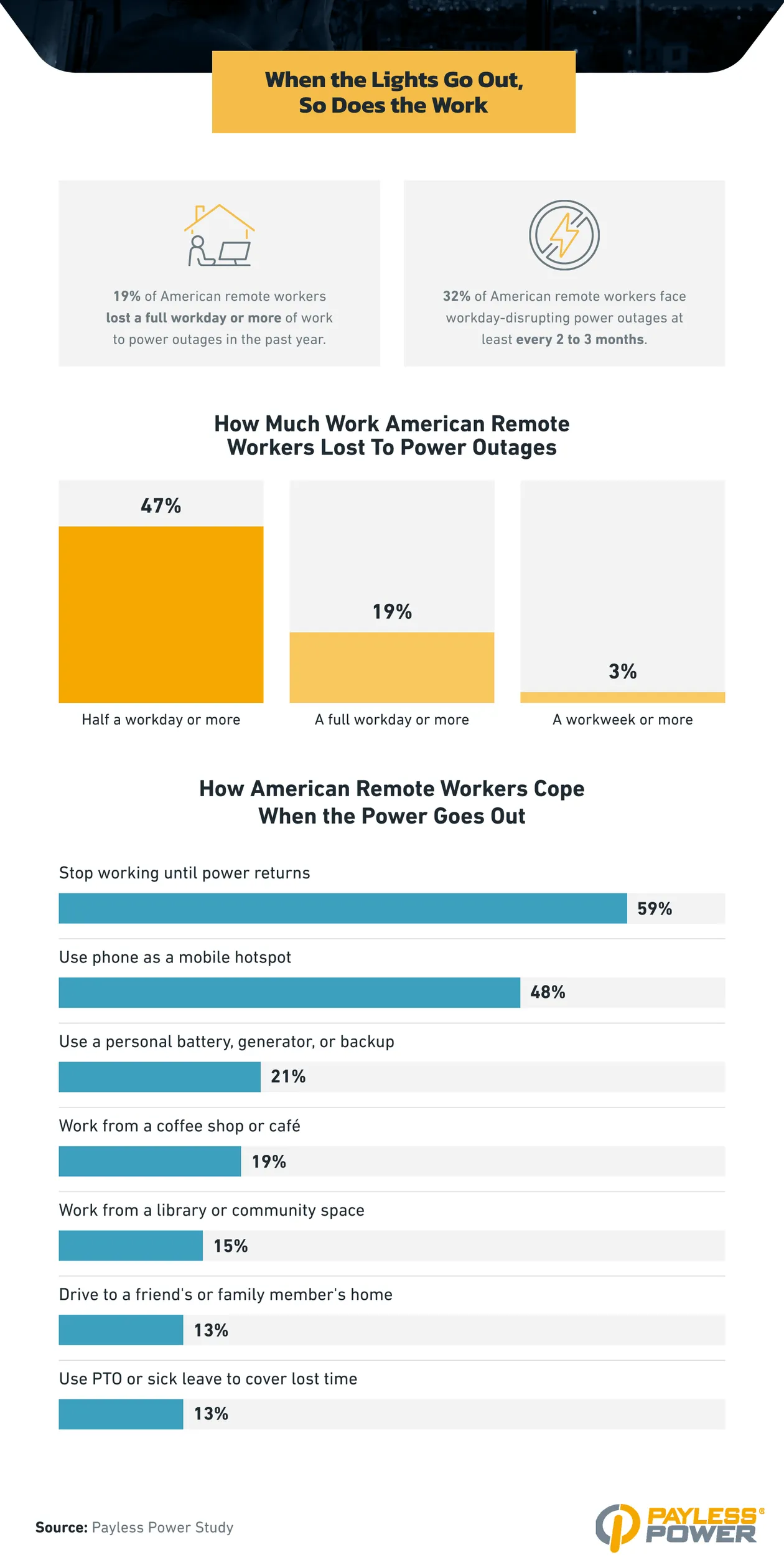
- Nearly 4 in 5 American remote workers (79%) have lost at least an hour of work to power outages in the past year.
- About half (47%) lost half a workday or more, 19% lost a full workday or more, and 3% lost a full workweek or more.
- When the power went out, most workers simply stopped. More than half (59%) waited until power returned, while 48% turned their phone into a mobile hotspot to keep going. Fewer leaned on a personal battery, generator, or backup (21%), decamped to a coffee shop or café (19%), or worked from a library or community space (15%).
- Almost a third of American remote workers (32%) face workday-disrupting outages at least every two to three months.
- More than 2 in 5 (42%) have no backup power or connectivity equipment to keep working through an outage.
- Retail workers lose the most time of any industry: 30% had lost more than eight hours of work to outages in the past year.
- Tech, retail, and education are the industries most likely to report monthly or more-frequent outages.
When Outages Threaten Paychecks and Promotions
The damage does not stop when the lights come back on. For many workers, the bigger cost shows up in their performance reviews, their bank accounts, and their stress levels.
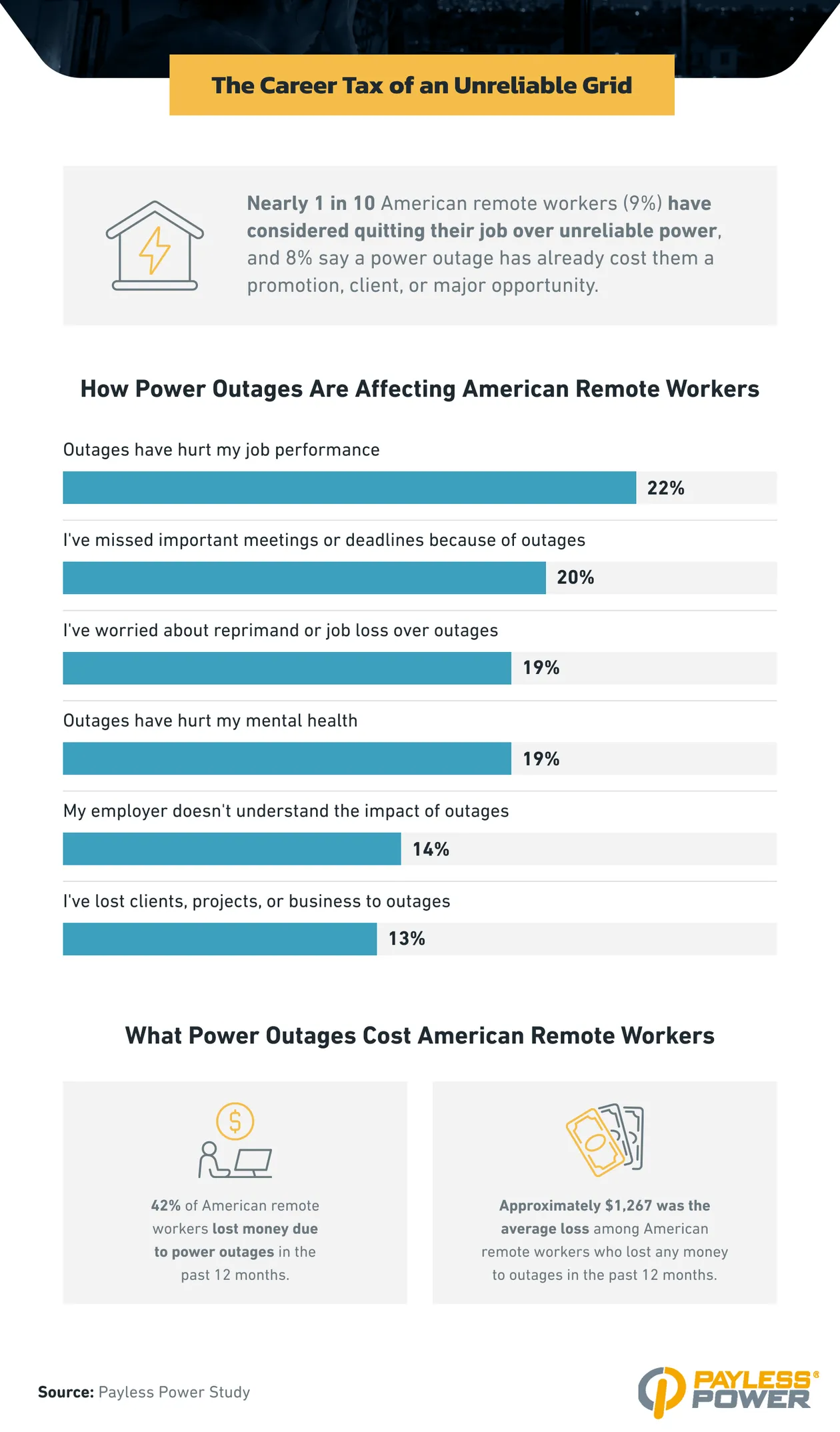
- Nearly 1 in 10 American remote workers (9%) considered quitting their job over unreliable power, and 8% said an outage had already cost them a promotion, client, or major opportunity.
- Outages hurt job performance for 22% of remote workers, the most common impact reported. Beyond that, 20% missed important meetings or deadlines, 19% worry about reprimand or job loss, 19% say outages hurt their mental health, 14% feel their employer does not understand the impact, and 13% lost clients, projects, or business.
- More than 2 in 5 American remote workers (42%) lost money to outages in the past year, and among those who did, the average hit was about $1,267.
- A quarter of Gen Z remote workers (25%) say outages hurt their mental health, well above the 19% reported across all workers.
- One in 10 Gen Z and millennial remote workers considered quitting because of unreliable power.
- Hybrid workers are more likely than fully remote workers to miss meetings or deadlines because of outages (23% vs. 16%).
- Average losses vary sharply by industry. Media and entertainment workers who lost money in the past year report the steepest average loss at about $4,074, compared with roughly $1,356 for retail and $1,243 for tech.
- When employers do step in, these are the most common ways they support remote workers through an outage:
-
- Allow flexible hours to make up lost work.
- Send communications acknowledging the issue.
- Grant PTO for outage-related disruptions.
- Provide access to a coworking space, office, or hotel.
- Reimburse equipment for backup power.
Methodology
Payless Power surveyed 1,008 American fully remote and hybrid workers about how power outages affect their workday. All respondents had experienced at least one workday-disrupting power outage in the past 12 months. We asked about the frequency and duration of outages, how people cope when the power goes out, the financial and career impact of those outages, what backup equipment they had purchased, and how their employers responded.
Respondents by generation were 52% millennials, 24% Gen X, 17% Gen Z, and 6% baby boomers. By work arrangement, 51% were fully remote and 49% hybrid. The survey was fielded on May 14, 2026.
About Payless Power
As remote and hybrid work make a steady connection essential, an unexpected outage can mean lost hours and lost income. Payless Power offers flexible prepaid electricity plans that give Texas residents more visibility and control over what they spend on power every month. Explore Payless Power’s plans to see how much you could save.
Fair Use Statement
The data, findings, and visuals contained in this study are free to share and republish for noncommercial purposes. Please provide a link back to Payless Power so readers can access the full research and methodology.
Payless Power is a thought leader in the energy industry, focusing on technology, innovation, and accessibility. The company's expertise includes the Texas energy grid, infrastructure improvements, weatherization safeguards, and the advancement of clean, renewable resources. Since 2005, Payless Power has provided energy solutions to residences and businesses across the Lone Star state.





What our customers are saying
See why our power customers say we're the best electricity provider in Texas!

I was worried about getting electricity for my home through a prepaid company. I was calling around to see different rates then going through all the hassle of credit checks while dropping points each…
I have been with this company for several years and have been very happy since. Even when I moved, they made my usually stressful situation very easy and carefree. I recommend them to everyone that I…
I have enjoyed the service for 2 years now. In the beginning this service was planned to be temporary but with the service being so effective for me i decided to keep it for the long haul. I’m a happy customer.
*Same-day connection is available Monday through Saturday when you fund your account before 6:00 PM. Accounts funded after 6:00 PM, on Sundays, or on holidays will be connected first thing the next morning. Actual timing depends on your local utility company. Connection times are not guaranteed and may be delayed due to meter issues, switch holds, system outages, or weather. Our support team is always standing by to help.
About Payless Power
Payless Power wants to be your Texas electric company.
Whether you live in a large city or small town, Payless Power can save you money on your Texas electricity. We serve customers in over 400 deregulated communities in Texas with both traditional, postpaid plans on monthly billing cycles, and prepaid electricity that is pay-as-you-go with no deposit or credit check required.
We work with principal utilities throughout the state to provide electricity. The utilities are: Oncor in the Dallas and Fort Worth Metroplex and various parts of West Texas; CenterPoint Energy in Houston and the surrounding areas; AEP Central in Corpus Christi and surrounding areas; and AEP North in Abilene and other North Texas communities.