
New Customer Hours
Mon - Sat: 9:00am - 5:00pm
Customer Care Hours
Mon - Sat: 9:00am - 5:00pm
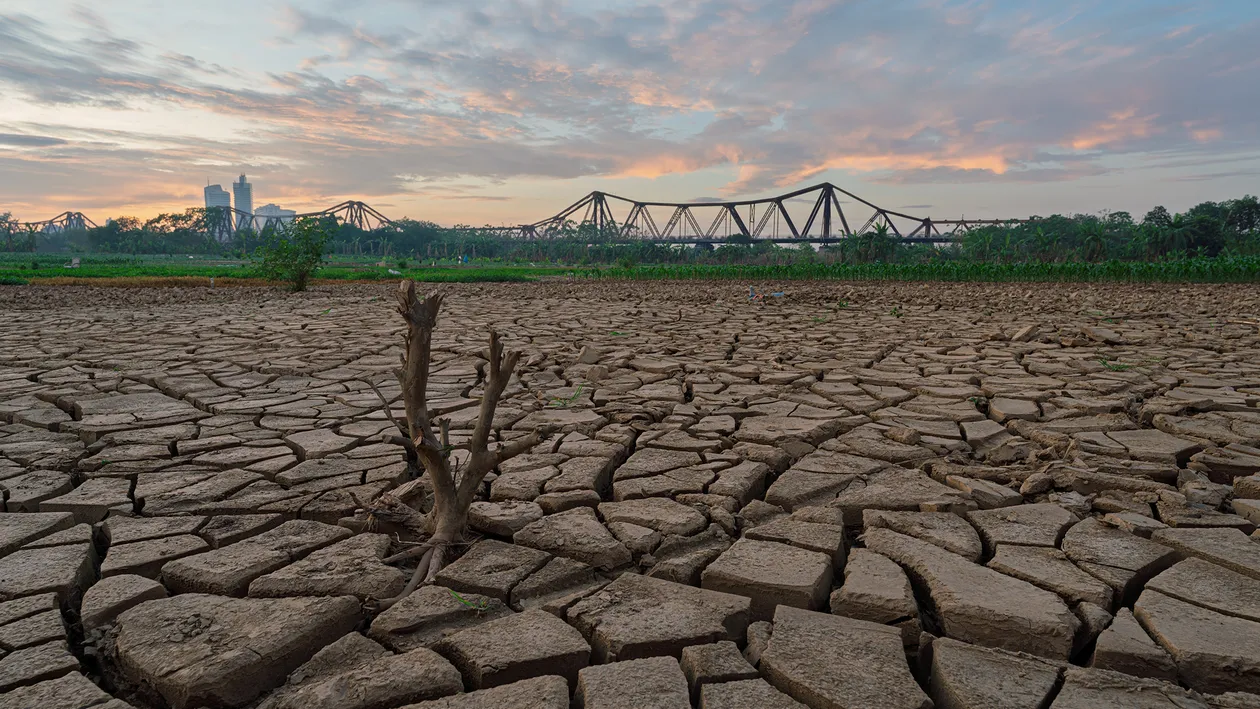
The American West has been losing rainfall for decades, but new data reveals just how far the drying trend has spread, and how much further it may go. Payless Power analyzed 30 years of precipitation data, historical drought exposure, and climate model projections for all 48 contiguous U.S. states to identify where rain is disappearing fastest, where drought has become the norm, and which states are on course to get significantly drier by 2036.
Key Takeaways
- Arizona now gets 15% less rain than it did 30 years ago, nearly double the drop of any other state.
- Arizona, New Mexico, and Nevada are the top 3 states receiving less rain than they did 30 years ago.
- 21 of 48 states spend more than half the year in drought conditions.
- Washington tops the nation in 10-year dryness risk, with 69% of climate models projecting a drier future there.
- The West spends 75% of its weeks in drought, about 3.5 times the rate of the Northeast.
- All 8 “accelerator” states, already receiving less rain and projected by most models to dry further, are in the American West.
- Kentucky now gets 6% more rain than 30 years ago, but 57% of climate models still project it will trend drier by 2036.
A State-by-State Ranking of Where Precipitation Is Disappearing Fastest
Rainfall totals have shifted across the country over the past three decades, but the losses are concentrated almost entirely in the West. Here is how each state stacks up on precipitation change and historical drought exposure.
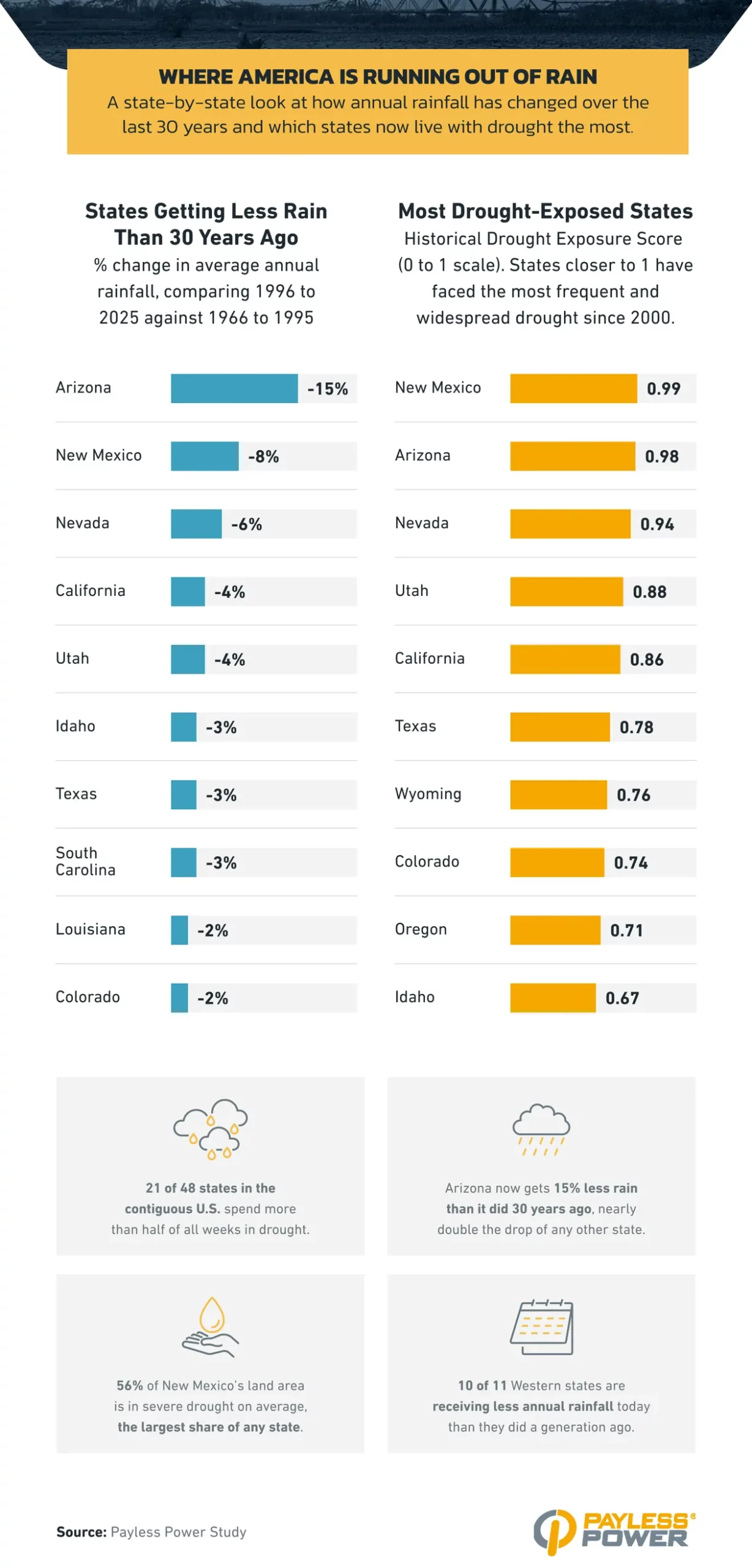
Across the contiguous U.S., 17 of 48 states receive less annual rainfall today than they did 30 years ago. The losses are overwhelmingly concentrated in the West, where 10 of 11 states are getting less rain than they did a generation ago. In the South, 7 of 16 states are in the same situation.
On average, states spend 48% of their weeks in drought, with drought covering at least 5% of the state. And 21 of 48 spend more than half of all weeks in
drought conditions. Arizona leads the nation in rainfall loss, now receiving 15% less rain per year than it did 30 years ago, nearly double the drop of any other state.
New Mexico (0.99) and Arizona (0.98) sit at the top of the Historical Drought Exposure Score, a composite index measuring how often and how widely drought has affected each state since 2000. Every state in the top 10 for drought exposure is in the American West. New Mexico also leads the country in severe drought coverage, with 56% of its land area in severe drought on average.
Where Drought Risk Is Projected To Rise in the Short, Medium, and Long Term
Historical trends tell us where the drying has already happened. Climate model projections reveal where it is headed next, and the outlook shifts noticeably depending on how far out you look.
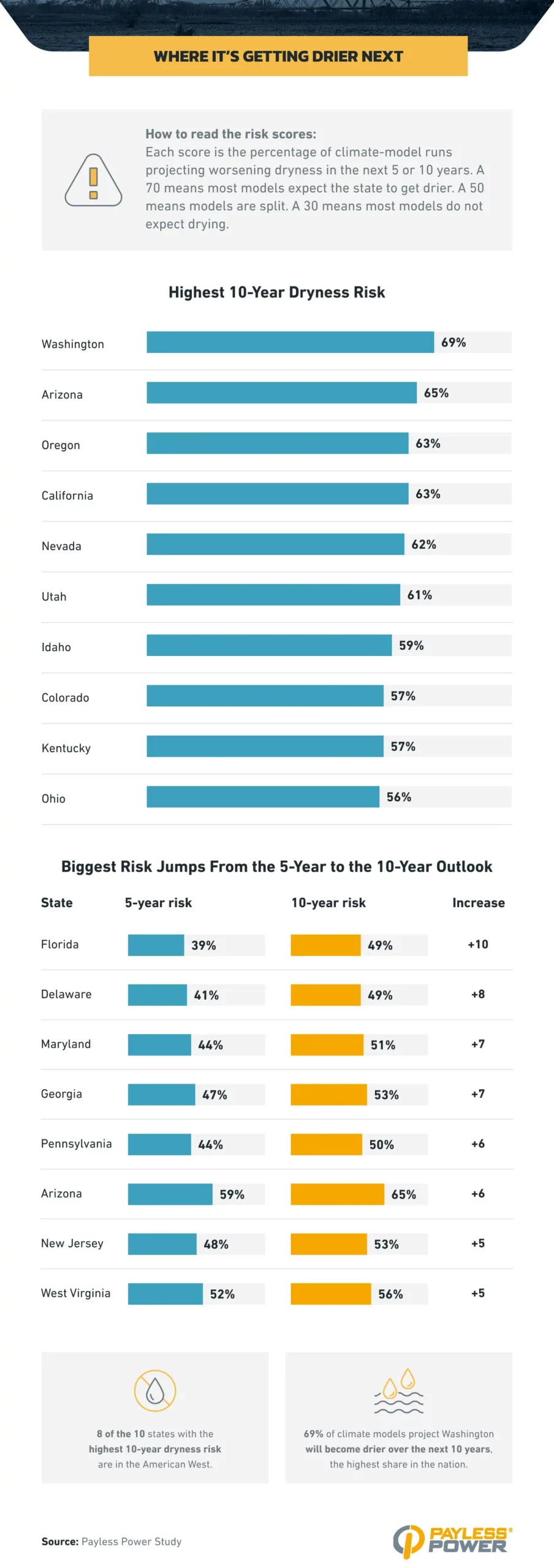
Washington state leads the nation in 10-year dryness risk, with 69% of climate models projecting it will become drier over the next decade. It is followed by Arizona (65%), Oregon (63%), California (63%), and Nevada (62%). Eight of the 10 states with the highest 10-year dryness risk are in the American West. Notably, no state scores below 43 for 10-year risk, meaning that even in the least exposed states, at least 4 in 10 climate models are projecting drying conditions ahead.
The picture also shifts when comparing 5-year and 10-year outlooks. Florida shows the largest jump, with model agreement on drying rising from 39% to 49%, a 10-point increase. Five of the 10 biggest risk climbers between the two timeframes are on the Atlantic Seaboard, including Florida, Delaware, Maryland, Georgia, and New Jersey.
How Historical Trends Compare to What Is Coming Next
Looking at past rainfall loss and future projections together reveals a troubling pattern. The states already drying out are largely the same ones most likely to keep drying, while a new wave of states that have historically been wet are now appearing on the radar.
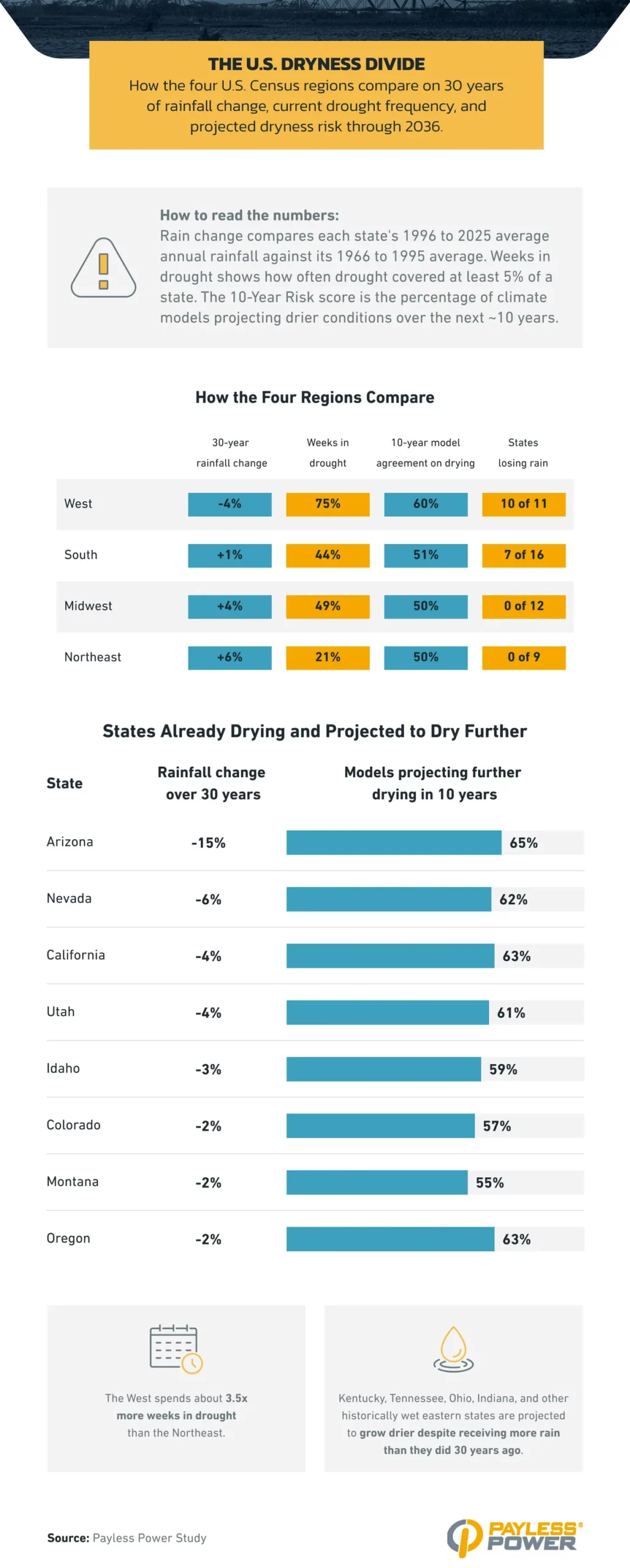
The West spends about 3.5 times more weeks in drought than the Northeast. Eight Western states meet a “double exposure” criterion, meaning they have both lost rainfall over the last 30 years and have at least 55% of climate models projecting continued drying ahead. Arizona is the clearest example, having shed 15% of its annual rainfall over three decades, while 65% of models project further drying.
But the concern is spreading beyond historically dry regions. 10 states with historically high rainfall (averaging above 40 inches annually) now have at least 48% model agreement on future drying. Kentucky is a notable example. Despite receiving 6% more rain than it did 30 years ago, 57% of climate models project it will trend drier over the next decade.
The Drying of America Is Already Well Underway
The data makes clear that water scarcity is no longer a distant concern for the American West. It is already the baseline reality for millions of residents across 21 states that spend more than half the year in drought. What the climate projections add is urgency. The states most at risk are not just dry today, they are on a trajectory to become significantly drier within the decade.
For households in high-risk states, particularly in Texas and across the Southwest, keeping a close eye on energy and water costs is a practical first step toward managing what is already a shifting climate reality.
Methodology
This analysis ranks the 48 contiguous U.S. states on rainfall change, drought exposure, and projected future dryness. Alaska and Hawaii are not included.
- Rainfall change compares each state’s average annual precipitation from 1996–2025 against its 1966–1995 average. Data comes from the NOAA NCEI Statewide Time Series. How to read: A value of -15% means the state now receives 15% less rain per year, on average, than it did in the 30 years before 1996. Positive values mean the state is getting more rain than it used to.
- Drought exposure combines the share of weeks in drought, average share of state area in drought, and average share in severe drought into a 0–1 score. Data is for 2000 to 2025 and is from the U.S. Drought Monitor. How to read: States closer to 1 have faced the most frequent and widespread drought since 2000. A score of 0.90 means a state is among the most drought-exposed in the country; a score near 0 means drought has been rare.
- Dryness risk is the share of climate-model runs projecting drier conditions over the next 5 and 10 years. Data from USGS Revised CMIP6-LOCA2 (v20240915). How to read: A score of 70 means 70% of climate models expect the state to get drier. A score of 50 means models are split. A score of 30 means most models do not expect drying.
About Payless Power
Payless Power is a prepaid electricity provider serving Texas residents with flexible, no-contract plans built for people who want more control over what they spend on energy. With no credit check required and real-time usage alerts to help you stay on budget, Payless Power makes it easier to manage your electricity bill.
Fair Use Statement
The data and findings in this study may be republished and shared for non-commercial purposes with proper credit to Payless Power and a link back to the original article.
Payless Power is a thought leader in the energy industry, focusing on technology, innovation, and accessibility. The company's expertise includes the Texas energy grid, infrastructure improvements, weatherization safeguards, and the advancement of clean, renewable resources. Since 2005, Payless Power has provided energy solutions to residences and businesses across the Lone Star state.



What our customers are saying
See why our power customers say we're the best electricity provider in Texas!

I was worried about getting electricity for my home through a prepaid company. I was calling around to see different rates then going through all the hassle of credit checks while dropping points each…
I have been with this company for several years and have been very happy since. Even when I moved, they made my usually stressful situation very easy and carefree. I recommend them to everyone that I…
I have enjoyed the service for 2 years now. In the beginning this service was planned to be temporary but with the service being so effective for me i decided to keep it for the long haul. I’m a happy customer.
*Same-day connection is available Monday through Saturday when you fund your account before 6:00 PM. Accounts funded after 6:00 PM, on Sundays, or on holidays will be connected first thing the next morning. Actual timing depends on your local utility company. Connection times are not guaranteed and may be delayed due to meter issues, switch holds, system outages, or weather. Our support team is always standing by to help.
About Payless Power
Payless Power wants to be your Texas electric company.
Whether you live in a large city or small town, Payless Power can save you money on your Texas electricity. We serve customers in over 400 deregulated communities in Texas with both traditional, postpaid plans on monthly billing cycles, and prepaid electricity that is pay-as-you-go with no deposit or credit check required.
We work with principal utilities throughout the state to provide electricity. The utilities are: Oncor in the Dallas and Fort Worth Metroplex and various parts of West Texas; CenterPoint Energy in Houston and the surrounding areas; AEP Central in Corpus Christi and surrounding areas; and AEP North in Abilene and other North Texas communities.